Solar Market · · Updated · 9 min read
Rooftop Solar With Battery Storage in India: Costs, Sizing and When It Pays
“Can I add a battery?” is now a common question in rooftop meetings. Customers have seen home batteries abroad, they live with power cuts, and they hear that battery prices are falling. The honest answer in India is: sometimes it pays, often it does not yet, and the reasons are more about tariffs than technology.

This guide explains when a battery makes financial or practical sense with rooftop solar in India, what batteries cost in 2026, how time-of-day tariffs change the picture, how to size a system and what to check before installing a hybrid setup.
Why most grid-connected homes don’t need a battery yet
Under net metering, the grid works like a free battery. A unit exported at noon offsets a unit imported at night at the full retail tariff. A physical battery that does the same job costs money, loses a little energy in each cycle and wears out over time. As long as net metering is available and power cuts are rare, the grid is the cheaper battery.
That is why most PM Surya Ghar homes are installed without storage, and why the central subsidy is calculated on the solar capacity, not on batteries. If you want the background on settlement rules, read net metering vs net billing vs gross metering.
When a battery does make sense
1. Frequent or long power cuts
A standard grid-tied inverter shuts down when the grid fails, for safety. Without a battery and a hybrid inverter, a rooftop system produces nothing during a power cut — even at noon. In areas with regular outages, a battery gives backup for essential loads and lets the solar keep working. For many homes, shops and clinics, this reliability is the real reason to buy storage.
2. Net billing or gross metering
Where exports are paid at a feed-in rate well below the retail tariff, storing surplus solar to use in the evening becomes more valuable than exporting it.
3. Time-of-day tariffs
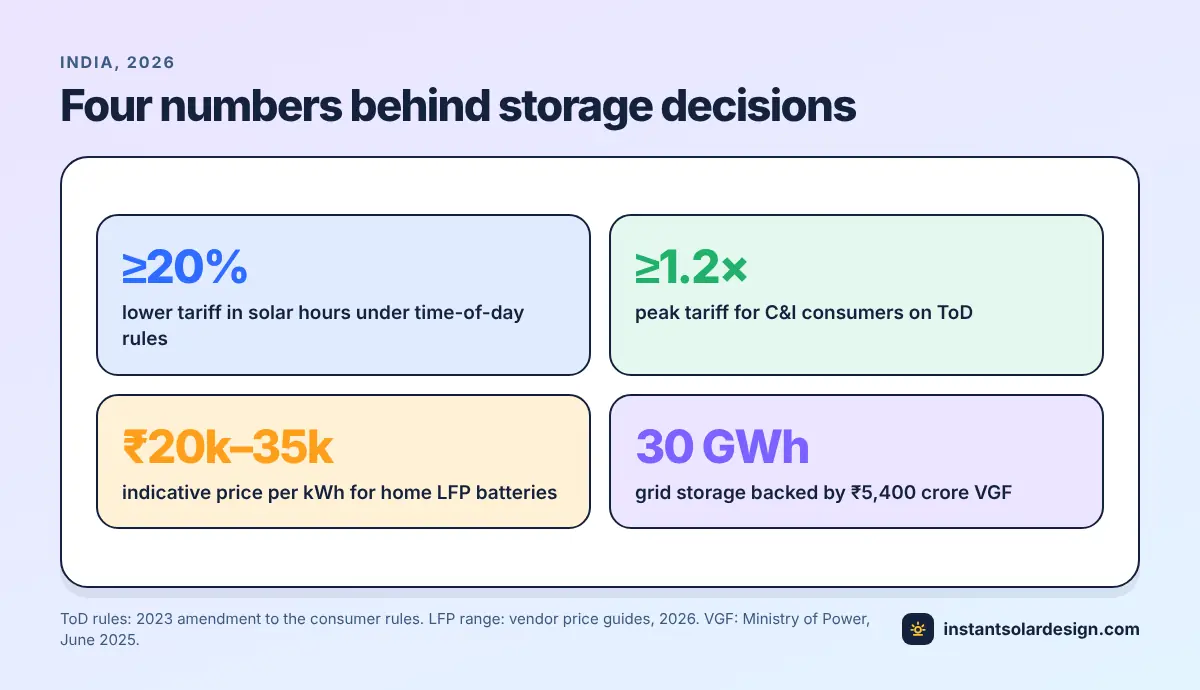
The 2023 amendment to the consumer rules requires tariffs in solar hours to be at least 20% lower than the normal tariff, and for commercial and industrial consumers the peak tariff must be at least 1.2 times normal. ToD applies where smart meters are installed, starting with larger C&I consumers. A battery that charges from solar at midday and discharges in the evening peak captures that spread.
4. Replacing diesel generators
Businesses that run diesel generators during outages pay a high cost per unit, plus maintenance and pollution. A solar-plus-battery system can cut generator hours sharply, which often gives the best payback of any storage use case.
5. Limits on exports
Where a DISCOM limits export because the local transformer is full, a battery lets a larger solar system be used on site instead of being curtailed.
What batteries cost in 2026
Lithium iron phosphate (LFP) is now the standard chemistry for solar storage in India. It is safer than other lithium chemistries, tolerates heat better and lasts thousands of cycles. Price guides published by Indian vendors in 2026 put home LFP batteries at roughly ₹20,000–35,000 per kWh, with common 2.4–5 kWh units at around ₹55,000–1,00,000. Commercial-scale systems cost less per kWh.
Lead-acid batteries are cheaper upfront — roughly ₹8,000–15,000 per kWh — but they tolerate fewer cycles and shallower discharge, so their cost per kWh delivered over their life is usually higher than LFP. For daily solar cycling, LFP is almost always the better choice.
These figures come from sellers, and quotes vary widely. Ask for an itemised price that separates the battery, the hybrid inverter and installation, and compare the warranty in cycles and years.
Sizing a home battery
The most common mistake is sizing a battery for the whole house. Size it for the loads that genuinely need backup:
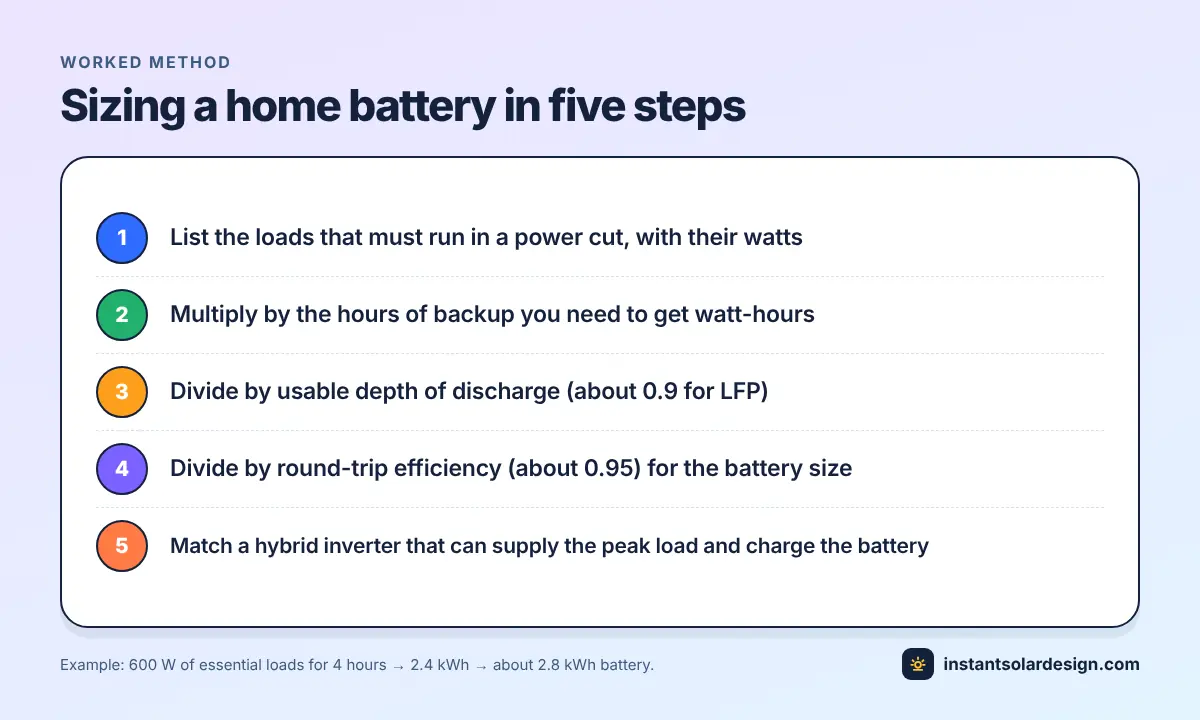
Worked example for a typical home: a refrigerator (150 W), four fans (240 W), lights (100 W), a Wi-Fi router (20 W) and a TV (100 W) add up to about 600 W. Four hours of backup needs 2.4 kWh. Allowing for about 90% usable depth of discharge and 95% round-trip efficiency gives roughly 2.8 kWh — so a 3 kWh battery is sensible. Air-conditioners, geysers and induction cooktops change the answer dramatically; most homes keep them off the backup circuit.
Sizing for a business
For commercial and industrial customers, start from data rather than a list of appliances:
- Interval meter data (15-minute readings) shows when peaks happen and how large they are.
- The tariff order shows the peak hours, peak rates and any demand charges.
- Generator logs show how many hours of backup are needed and at what load.
From these, you can size a battery to cover the evening peak or the typical outage, and calculate the saving from each kWh shifted. A battery that cycles once a day in a meaningful peak-to-off-peak spread pays back much faster than one that sits idle waiting for outages.
A simple payback check for a business battery
For a C&I customer on a time-of-day tariff, the core of the calculation is the value of each kWh moved from solar hours to peak hours. Take an illustrative normal tariff of ₹8 per unit. Under the minimum ToD rules, the solar-hour rate would be ₹6.40 (20% lower) and the peak rate ₹9.60 (1.2 times normal).
- A kWh of solar used at midday saves ₹6.40.
- Stored and used at peak, after about 5% round-trip loss, the same kWh saves about ₹9.12.
- The battery therefore adds roughly ₹2.70 of value for every kWh it shifts.
A battery shifting 100 kWh a day for 300 days a year adds about ₹81,000 a year from the tariff spread alone. Divide the installed battery cost by that figure to get a simple payback, then compare it with the battery’s warranty life. In many cases the tariff spread alone is not enough — but add avoided diesel generation, reduced demand charges or backup for critical processes, and the case can become strong. Use the customer’s actual tariff order: many states have spreads wider than the minimum.
Choosing a hybrid inverter
A hybrid inverter manages the solar array, the battery and the grid together. When choosing one, check:
- Battery compatibility: the inverter must support the battery’s chemistry, voltage and communication protocol.
- Backup power rating: the inverter’s backup output must cover the peak of the essential loads, including motor starting currents for pumps or refrigerators.
- Switch-over time: some loads, such as computers, need near-instant changeover.
- DISCOM approval: the inverter model should meet the grid-connection standards your DISCOM accepts for net metering.
- Monitoring: app-based monitoring helps you and the customer see how the battery is being used.
Grid-scale storage and why it matters to rooftop installers
In June 2025 the Ministry of Power approved ₹5,400 crore of viability gap funding for 30 GWh of grid-scale battery storage, on top of an earlier scheme supporting 13.2 GWh. Grid-scale storage is built by large developers, not rooftop installers, but it has two effects on your market. It pushes battery manufacturing and supply chains to scale up in India, which should lower prices for smaller systems over time. And it makes evening power more valuable to DISCOMs, which is the logic behind time-of-day tariffs.
Safety and installation basics
- Install batteries in a ventilated, shaded place away from direct sun and water.
- Use the manufacturer’s recommended cables, fuses and isolators.
- Keep batteries away from bedrooms and escape routes where possible.
- Label the system clearly so electricians know it can be live during a grid outage.
- Explain to the customer what the battery will and will not run.
How to talk about batteries with customers
Customers often expect a battery to make them “independent of the grid”. In most Indian homes, that would need a very large battery and is rarely worth it. A better framing is:
“Your solar will save the most money with net metering. A battery is for keeping your essential loads running during power cuts. If cuts are rare here, you may not need one. If they are frequent, a 3 kWh battery will run your fridge, fans, lights and Wi-Fi for about four hours.”
For businesses, show the numbers: peak tariff spread, generator cost per unit and the expected payback. Our post on building trust in savings numbers explains why transparent assumptions win more orders.
Checklist before quoting a battery
- Is the customer on net metering, net billing or a ToD tariff?
- How often and how long are power cuts?
- Which loads truly need backup?
- Is there a diesel generator, and how many hours does it run?
- Is the hybrid inverter approved by the DISCOM?
- Where will the battery be installed safely?
Battery prices are indicative ranges from Indian vendor guides published in 2026; tariff rules are as reported up to November 2026. Get itemised quotes and check your state’s tariff order before deciding.
Planning solar plus storage?
Start with an accurate generation profile.
We model the roof and estimate generation so you can size the solar and the battery together — from ₹500 per project.
Order a design →Frequently asked questions
Do I need a battery with rooftop solar in India?
Not usually. With net metering and reliable grid supply, the grid acts as a cheaper battery. A battery makes sense for frequent power cuts, net billing, time-of-day tariffs or replacing diesel generators.
How much does a solar battery cost in India in 2026?
Vendor price guides put home LFP batteries at roughly ₹20,000–35,000 per kWh in 2026, with common 2.4–5 kWh units at around ₹55,000–1,00,000. Get itemised quotes, as prices vary widely.
Does rooftop solar work during a power cut?
A standard grid-tied system shuts down during a power cut for safety. To keep running, you need a hybrid inverter and a battery.
What size battery does a home need?
Add up the essential loads, multiply by backup hours and allow for depth of discharge and efficiency. For 600 W of essential loads over 4 hours, a battery of about 3 kWh is typical.
Does PM Surya Ghar subsidy cover batteries?
The central subsidy is calculated per kW of grid-connected solar capacity. Batteries are generally not part of the subsidy calculation.