Solar Market · · Updated · 8 min read
C&I Solar in India: Rooftop, Green Open Access or Group Captive?
A factory owner in Pune, a hospital in Lucknow and a cold-storage operator in Gujarat all want the same thing from solar: a lower, more predictable power bill. But they can buy it in very different ways — panels on their own roof, power wheeled from a solar plant elsewhere, or a share in a plant built with other consumers. Choosing the wrong route can halve the savings.

This guide explains the three main routes for commercial and industrial (C&I) solar in India in 2026, the rules that shape each, how time-of-day tariffs change the economics, and a practical process for advising a business customer.
Route 1: on-site rooftop solar
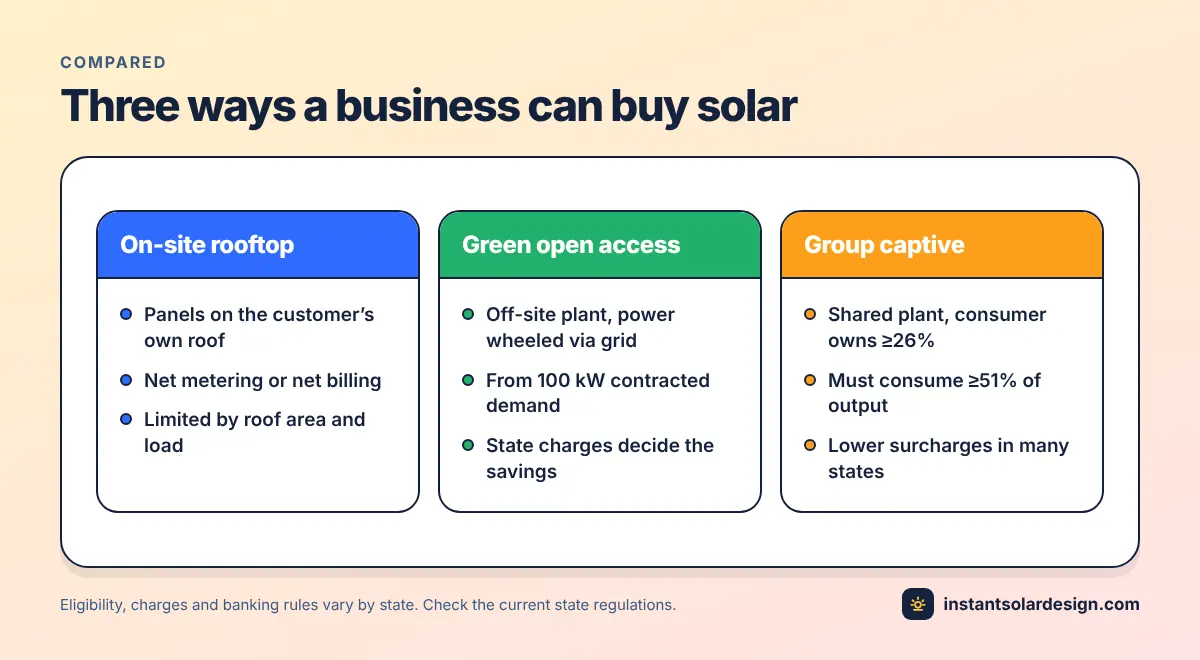
Panels on the customer’s own roof or carport, connected behind the meter. The power is used on site first, and surplus is settled with the DISCOM under net metering or net billing.
Strengths
- No wheeling, transmission or open-access surcharges — every unit used on site avoids the full grid tariff.
- Simple approvals compared with open access.
- The customer can own the system (capex) or buy power from a developer who owns it (RESCO / OPEX model).
Limits
- Roof area caps the size. As a rough guide, a flat roof needs about 6.5–10 square metres per kW depending on module, tilt and spacing.
- Structural capacity, especially on older metal sheds, can limit what is possible. See selling solar for metal sheds.
- Net metering usually applies only up to 500 kW or the sanctioned load, whichever is lower, unless state regulations say otherwise; above that, net billing or gross metering applies. Our net metering guide explains the difference.
Route 2: green energy open access
Open access lets a consumer buy power from a generator other than its DISCOM, using the grid to deliver it. The Green Energy Open Access Rules of 2022 made this much easier for renewable power:
- The eligibility threshold fell from 1 MW to 100 kW. Consumers can meet it with a single connection or by combining multiple connections under the same distribution licensee.
- The rules set timelines for processing applications, aiming to make approvals faster and more predictable.
- Captive consumers setting up green energy projects are not bound by the load limit.
States implement the rules through their own regulations, and details differ. In 2026, for example, the Delhi regulator proposed removing an 11 kV connection condition so more consumers could qualify, while keeping the 100 kW threshold.
What decides the savings
Open-access power is cheap at the plant, but several charges are added before it reaches the customer: transmission and wheeling charges, losses, cross-subsidy surcharge, additional surcharge where applicable, banking charges and scheduling costs. In some states these add little; in others they wipe out most of the saving. A proper open-access proposal always starts with the current charges in the customer’s state and category.
Route 3: group captive
Under group captive, several consumers jointly own a generating plant through a special purpose vehicle. To qualify as captive under the Electricity Rules, 2005, the consumers must together hold at least 26% of the ownership and consume at least 51% of the electricity generated, in proportion to their shareholding.
In many states, captive consumption is exempt from cross-subsidy surcharge and additional surcharge, which can make group captive cheaper than ordinary open access. The trade-offs are an equity investment, more paperwork and the need to keep meeting the captive conditions every year.
How time-of-day tariffs change C&I solar
Time-of-day tariffs now apply to many C&I consumers with smart meters. The rules require the solar-hour tariff to be at least 20% lower than the normal tariff, and the peak tariff for C&I consumers to be at least 1.2 times normal.
This has a subtle effect. On-site solar produces during solar hours, when grid power is now cheaper, so each rooftop unit saves a little less than it used to. Meanwhile, evening peak units cost more. Three responses make sense:
- Shift flexible loads into the day: pumping, compressors, cold-storage pre-cooling and batch processes.
- Consider storage: a battery that moves solar energy into the peak captures the spread. See rooftop solar with battery storage.
- Use open-access profiles wisely: wind-solar hybrid or storage-backed open-access supply can cover evening hours that rooftop cannot.
Which route for which customer?
| Customer situation | Usual starting point |
|---|---|
| Small business, good roof, load under the net-metering limit | Rooftop, owned or RESCO |
| Large factory, roof covers only part of the load | Rooftop plus open access for the balance |
| Multi-site company in one state | Open access or group captive, with rooftop at each site |
| Heavy evening or night load | Open access with hybrid or storage-backed supply |
| Tenant with a short lease | Open access, or RESCO rooftop with a transfer clause |
In practice, rooftop is almost always the first step because it has no surcharges. Open access or group captive then fills the gap between what the roof can produce and what the business uses.
Worked example: a mid-sized factory
Consider an illustrative engineering unit that uses about 12 lakh units of electricity a year and has a flat roof of about 1,300 square metres.
- Rooftop first. At roughly 8–9 square metres per kW, the roof fits about 150 kW. At an illustrative 1,450 units per kW per year, that is about 2.2 lakh units — roughly 18% of the factory’s use, all consumed on site with no surcharges.
- Open access for the balance. A 500 kW share of an off-site plant could supply around 7 lakh units a year, subject to the state’s banking rules and how well generation matches the factory’s working hours.
- The deciding number is the landed cost of open-access power: the generation tariff plus transmission and wheeling charges, losses, cross-subsidy and additional surcharges where they apply, and banking charges. If that landed cost is well below the factory’s grid energy charge in the hours it applies, open access adds real savings; if not, rooftop alone may be the better plan.
Together, the two routes could cover well over half of this factory’s consumption — something neither could do alone. The same logic scales up for larger companies and down for smaller ones, where rooftop alone often covers most of the load.
Capex or OPEX?
Businesses can own a rooftop system (capex) or sign a power purchase agreement with a developer who builds, owns and maintains it (OPEX or RESCO). Capex usually gives the highest lifetime savings and may allow depreciation benefits; OPEX needs no upfront investment and transfers performance risk to the developer. Companies with spare capital and a long-term site usually prefer capex; growing companies and tenants often prefer OPEX. A good proposal shows both.
A feasibility process that wins orders
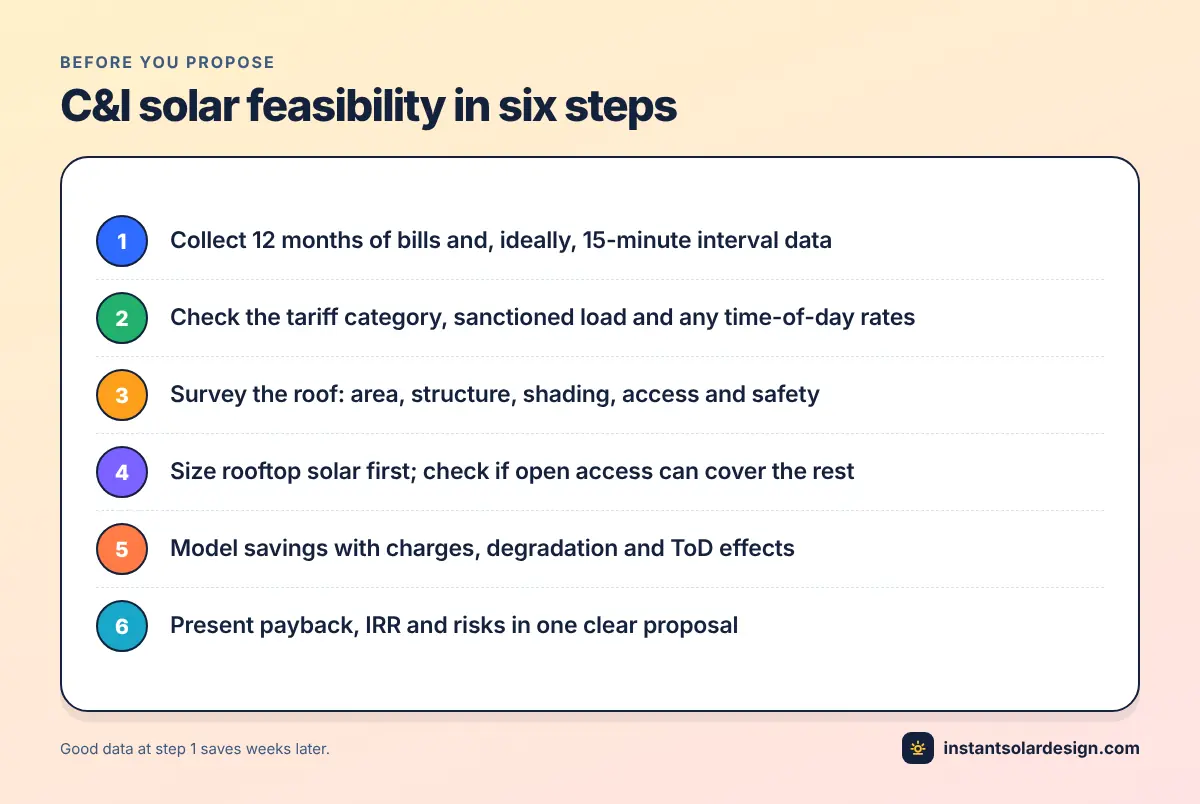
A few details make the difference between a proposal a CFO trusts and one that gets filed away:
- Use interval data where possible. Monthly bills hide when power is used. Fifteen-minute data shows how much solar will be self-consumed.
- Show the charges line by line for open access. Decision makers have usually heard that “open access is cheap” and want to see why it is or is not in their case.
- Include degradation and tariff assumptions openly, with a sensitivity table.
- Attach drawings. Layout, structure and single-line diagrams reassure engineering and safety teams. See why commercial clients want drawings.
- Plan for module rules. Projects commissioned on net metering or open access after 31 December 2026 are expected to need ALMM List-II cells, which can change the module price. See ALMM List-II explained.
Risks to discuss upfront
- Regulatory change: surcharges, banking rules and ToD windows can change during a 20–25 year project.
- DISCOM approvals: delays in feasibility, metering or open-access approval affect commissioning dates.
- Site changes: expansions, new buildings next door or roof repairs can affect generation and access.
- Counterparty risk: for OPEX deals, the developer’s ability to operate for decades; for the developer, the customer’s ability to pay.
Customers respect installers who raise these risks themselves, and contracts that address them avoid disputes later.
Checklist for a C&I proposal
- 12 months of bills, tariff category and sanctioned load
- Interval data or a reasonable load profile
- Roof survey with photos, structure details and shading
- Rooftop size, generation estimate and self-consumption share
- Open-access or group-captive option with current state charges
- Capex and OPEX scenarios, with payback and IRR
- Drawings and a clear list of assumptions and risks
Rules and charges summarised here are as reported up to November 2026 and differ by state. Check the current regulations of the relevant state electricity regulatory commission before preparing a proposal.
Commercial proposals, faster
Layouts, shadow analysis and generation reports for C&I roofs.
Send the site. We return a 3D model and report you can build the proposal on — up to 100 kW for ₹5,000.
See design prices →Frequently asked questions
What is the minimum load for green energy open access in India?
The Green Energy Open Access Rules lowered the threshold from 1 MW to 100 kW. Consumers can usually meet it with one connection or by combining connections under the same distribution licensee. Captive consumers are not bound by the load limit.
What is group captive solar?
A plant jointly owned by several consumers who together hold at least 26% of the ownership and consume at least 51% of the power, in proportion to their shareholding, under the Electricity Rules, 2005.
Is rooftop or open access cheaper for a business?
Rooftop usually saves more per unit because there are no wheeling or surcharge costs, but roof area limits its size. Open access can supply much more energy; its savings depend on state charges.
How do time-of-day tariffs affect commercial solar?
Solar-hour tariffs must be at least 20% below normal, so each rooftop unit saves slightly less, while peak tariffs are at least 1.2 times normal for C&I. Load shifting and storage become more valuable.
Should a business buy solar on capex or OPEX?
Capex usually gives the highest lifetime savings for companies with capital and a long-term site. OPEX needs no upfront investment and suits growing companies and tenants. A good proposal compares both.
Sources
- Mercom — Consumers with 100 kW can avail green energy open access
- pv-tech — India changes rules to allow greater access to clean energy
- SolarQuarter — DERC proposes green energy open access expansion
- DERC — Explanatory memorandum, GEOA First Amendment
- Mercom — Consumers to pay 20% lower tariff during solar hours