Solar Market · · Updated · 9 min read
DCR vs Non-DCR Solar Panels: Price Gap, Rules and When Each Makes Sense
“DCR or non-DCR?” is one of the first questions a rooftop customer’s quote raises, and one of the easiest places to lose money if you get it wrong. A subsidised home system built with the wrong modules can lose its subsidy. A commercial system built with DCR modules it did not need can lose the order on price.

This guide explains the difference, where each is required, what the price gap looked like in 2026, how to make sure a DCR module is genuine, and how to choose for different kinds of projects.
What DCR means
DCR stands for Domestic Content Requirement. A DCR solar module is made in India using solar cells that were also made in India. A non-DCR module may be assembled in India, but its cells are imported — today mostly from China and South-East Asia.
Both kinds can be high quality. Both can be on MNRE’s Approved List of Models and Manufacturers (ALMM) List-I. The difference is the origin of the cell, and that matters because government schemes use DCR to support Indian cell manufacturing.
Where DCR is mandatory
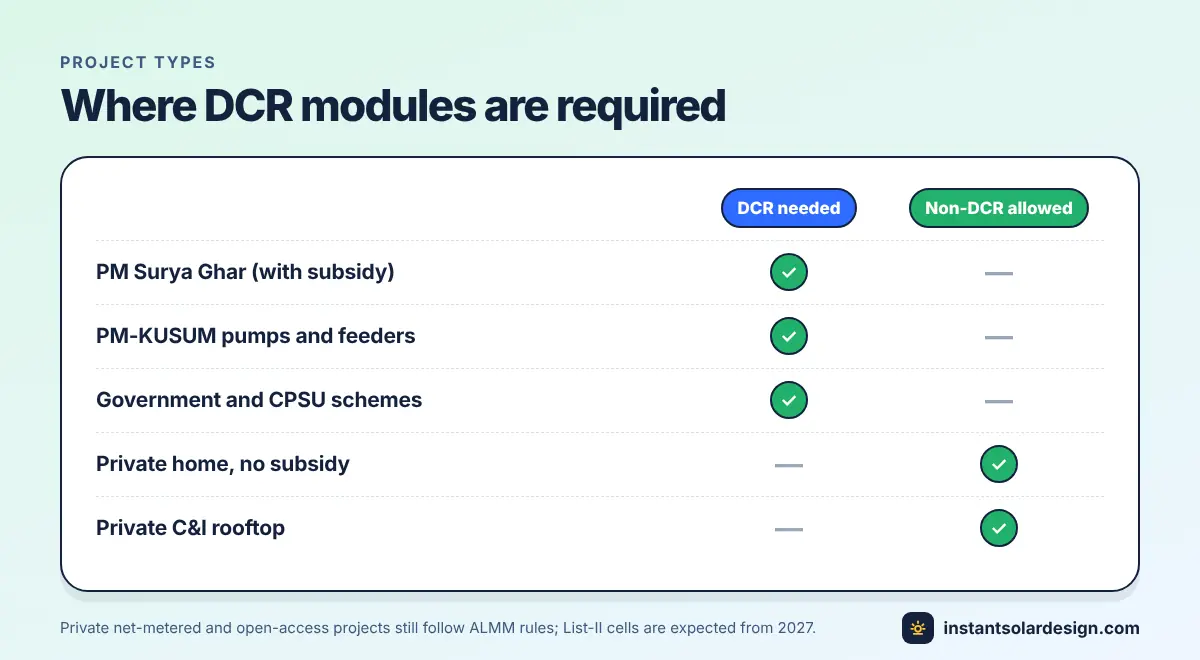
- PM Surya Ghar: Muft Bijli Yojana. Residential systems that claim the central subsidy must use DCR modules. If non-DCR modules are installed, the subsidy can be rejected.
- PM-KUSUM. Solar pumps and solarised agricultural feeders under the farm scheme use domestically made cells and modules.
- Government and public-sector schemes. Many central and state programmes, including projects for public-sector undertakings, specify domestic content.
Private homes that do not claim a subsidy, and private commercial and industrial projects, can usually choose non-DCR modules — as long as the module is on ALMM List-I where the ALMM order applies. That flexibility is narrowing: since 1 June 2026, ALMM List-II requires Indian-made cells for covered projects, and private net-metered and open-access projects were given only until 31 December 2026 to commission without them. We explain the deadlines in ALMM List-II explained.
The 2026 price gap
Because India makes far fewer cells than modules — Mercom reported about 36.6 GW of cell capacity against about 261.7 GW of module capacity in June 2026 — DCR modules have been in short supply relative to demand. Reported 2026 bulk benchmarks, attributed to JMK Research, put:
- non-DCR Mono PERC at about ₹13.8 per watt-peak,
- non-DCR TOPCon at about ₹14.2 per watt-peak, and
- DCR TOPCon at about ₹22.3 per watt-peak.
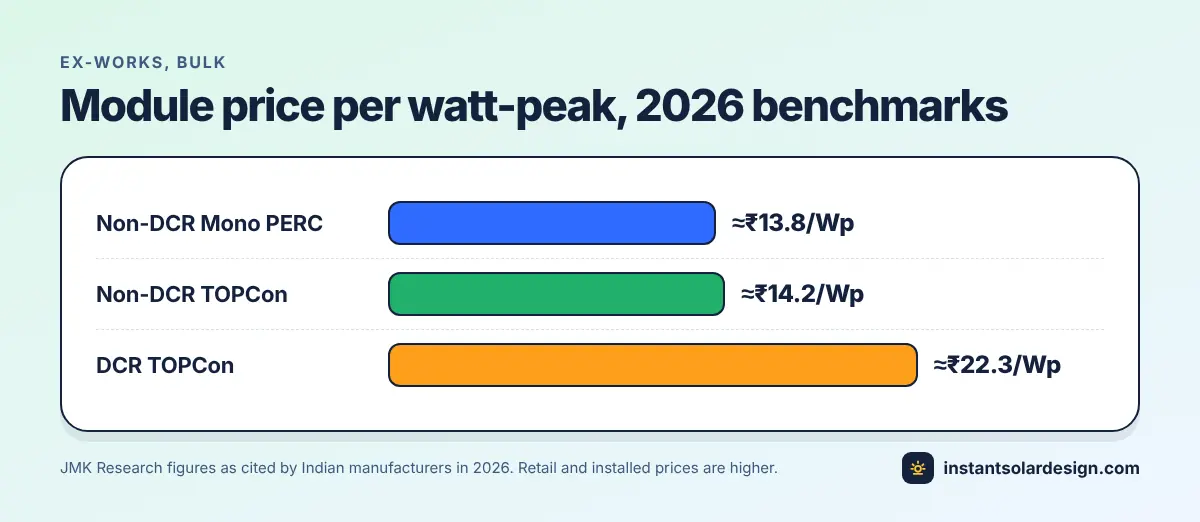
That is a premium of roughly ₹8 per watt, or about 55% over non-DCR TOPCon at these prices. Retail and installed prices are higher than these ex-works figures; one October 2026 survey of retail listings quoted ₹18–26 per watt for non-DCR and ₹24–34 per watt for DCR, including GST. Some analysts reported the DCR premium easing in the second half of 2026 as more cell lines started. Treat all of these as ranges and check current quotes before pricing a job.
Is DCR worth it for a subsidised home?
For a home claiming PM Surya Ghar subsidy, the question answers itself — the subsidy requires DCR. But it helps to show the customer the numbers. On a 3 kW system, a premium of ₹8 per watt adds about ₹24,000 to the module cost. The central subsidy for 3 kW is ₹78,000. Even at the high end of the premium, the customer is far better off with DCR modules and the subsidy than with cheaper modules and no subsidy.
That simple comparison closes a lot of arguments with price-sensitive customers who have seen non-DCR prices online.
Where the maths flips: larger homes
The PM Surya Ghar subsidy is capped at ₹78,000, reached at 3 kW. The DCR premium, on the other hand, grows with every watt. Using a premium of ₹8 per watt as an illustration:
| Home system | Extra module cost for DCR | Central subsidy | Net benefit of DCR + subsidy |
|---|---|---|---|
| 3 kW | ≈ ₹24,000 | ₹78,000 | ≈ ₹54,000 |
| 5 kW | ≈ ₹40,000 | ₹78,000 | ≈ ₹38,000 |
| 10 kW | ≈ ₹80,000 | ₹78,000 | ≈ break-even |
For most homes, DCR with subsidy is clearly better. For a large home of around 10 kW, the two options come close, and other factors — the wait for subsidy credit, the paperwork, module availability and the customer’s preference — decide. If the premium falls, as some analysts expect, DCR with subsidy becomes attractive at larger sizes too. Re-run this table with current prices before advising a customer.
Does DCR mean better or worse quality?
Neither, by itself. DCR describes where the cell was made, not how good it is. Indian cell and module makers range from large, bankable manufacturers to small new entrants, exactly as importers do. Judge a module the same way regardless of label: the manufacturer’s track record, independent test reports, the power and product warranty, and who stands behind the warranty in India. The one real difference has been technology mix — DCR supply has leaned towards Mono PERC — which affects efficiency and heat performance more than reliability.
When non-DCR makes sense
Private commercial and industrial rooftops
A factory or warehouse that is not claiming a subsidy pays for every watt. On a 100 kW rooftop, a ₹8 premium is ₹8 lakh. Unless a policy requires DCR, non-DCR modules usually give the better payback — at least for projects commissioned before List-II cells become necessary. See our C&I solar guide for how these projects are evaluated.
Homes without subsidy
Larger homes above the subsidy slabs, second homes, or buyers who do not want to wait for subsidy can choose non-DCR if their state and DISCOM allow it. Explain the trade-off clearly and put the module choice in writing.
Projects with tight roof space
If the best-performing module for a small roof is only available as non-DCR, the extra generation per square metre may matter more than the label — provided no scheme rule requires DCR.
How to verify a genuine DCR module
Fake or mislabelled DCR modules are a real risk when supply is tight. A few checks protect you and your customer:
- Buy from the manufacturer or an authorised distributor. Unusually cheap “DCR” stock from an unknown trader is the biggest warning sign.
- Get the DCR certificate issued by the manufacturer for the specific consignment, listing module serial numbers.
- Match the serial numbers on the modules to the certificate before installation, not after.
- Check the model on ALMM List-I and the cell maker on List-II.
- Use the portal checks. For PM Surya Ghar, module details are verified on the national portal. Problems found at that stage delay subsidy for weeks.
- Keep the purchase invoice showing the DCR model and quantity in the project file.
DCR and technology choice
Many Indian cell lines began with Mono PERC technology, so DCR stock has often been PERC while the non-DCR market moved to TOPCon. That is changing as new TOPCon cell lines come online, but it means a DCR module may have slightly lower efficiency or a different size from the non-DCR module you usually stock. Re-check the layout, string sizing and structure when you switch. Our comparison of TOPCon, Mono PERC and HJT explains the performance differences.
How to present the choice to a customer
Customers rarely need the technical background. They need a clear choice:
| If you… | We recommend | Why |
|---|---|---|
| Want the PM Surya Ghar subsidy | DCR modules | Required for the subsidy |
| Run a business and are not claiming subsidy | Non-DCR (where allowed) | Lower cost per watt, faster payback |
| Are commissioning after 31 Dec 2026 on net metering | Modules with List-II cells | Expected ALMM requirement |
Put the module make, model, wattage and DCR status on the quotation. It avoids disputes when the delivery arrives, and it shows the customer you know the rules.
What could change in 2027
Two forces will shape the DCR market next year. First, ALMM List-II will extend Indian-cell requirements to more private projects, increasing demand for domestic cells. Second, new cell factories coming online will add supply. If supply grows faster than demand, the premium should shrink; if not, it may stay high. Either way, the gap between “DCR” and “non-DCR” as categories will matter less over time, because more projects will need Indian cells anyway.
For installers, the practical lesson is to build relationships with two or three reliable DCR suppliers now, rather than scrambling when a scheme deadline arrives.
Buying checklist
- Confirm whether the project needs DCR (subsidy, scheme, or ALMM rule).
- Get current per-watt quotes from at least two suppliers for both DCR and non-DCR.
- Check the module model on ALMM List-I and the cell maker on List-II.
- Collect the DCR certificate and match serial numbers before installation.
- Re-check layout and string design if the module size or wattage changes.
- State the module choice and DCR status on the quotation.
Prices and rules are as reported up to November 2026 and change often. Check the current ALMM lists, scheme guidelines and supplier quotes before pricing a project.
Switching modules?
Get the layout redone for the module you can source.
We rework rooftop layouts, string plans and generation reports for any module — from ₹500 per project, usually in 24 hours.
Order a design →Frequently asked questions
What is a DCR solar panel?
A DCR (Domestic Content Requirement) panel is a solar module made in India using solar cells that were also made in India.
Is DCR mandatory for PM Surya Ghar?
Yes. Residential systems claiming the central subsidy under PM Surya Ghar must use DCR modules; non-DCR modules can lead to the subsidy being rejected.
How much more do DCR panels cost?
Reported 2026 bulk benchmarks put DCR TOPCon at about ₹22.3 per watt-peak against about ₹14.2 for non-DCR TOPCon — a premium of roughly ₹8 per watt. Retail prices are higher and change often.
Can a business use non-DCR panels?
Usually yes, if it is not claiming a subsidy or working under a scheme that requires DCR, and the module is on ALMM List-I. From 2027, net-metered and open-access projects are expected to need List-II cells.
How do I check if a DCR module is genuine?
Buy from the manufacturer or an authorised distributor, get the DCR certificate listing serial numbers, match the serial numbers before installation, and check the model and cell maker against ALMM List-I and List-II.