Solar Market · · Updated · 9 min read
TOPCon vs Mono PERC vs HJT: Which Solar Panel Technology Should Indian EPCs Use?
Three years ago, almost every rooftop quote in India named a Mono PERC module. In 2026, most name TOPCon, and a few premium jobs use HJT. The shift happened fast, and many customers — and some salespeople — are not sure what the letters mean or whether the difference is worth paying for.

This guide explains the three technologies in practical terms, compares them on the numbers that matter in Indian conditions, and suggests which to choose for different projects. It also covers the supply-side reality: what you can actually buy, especially when a project needs domestic cells.
The short version
- Mono PERC is the mature, lowest-cost technology. It is being phased out by most manufacturers but remains common in domestic-content supply.
- TOPCon is the new mainstream: higher efficiency, better heat performance and better bifaciality than PERC, at a small price premium.
- HJT (heterojunction) is the premium option: the best heat performance and bifaciality, but higher cost and fewer suppliers in India.
Where the Indian market stands
Mercom’s data for June 2026 showed TOPCon at about 80% of India’s ALMM-listed module manufacturing capacity. Lines able to make both Mono PERC and TOPCon accounted for 11%, pure Mono PERC for 4%, HJT for 3% and thin film for 2%.
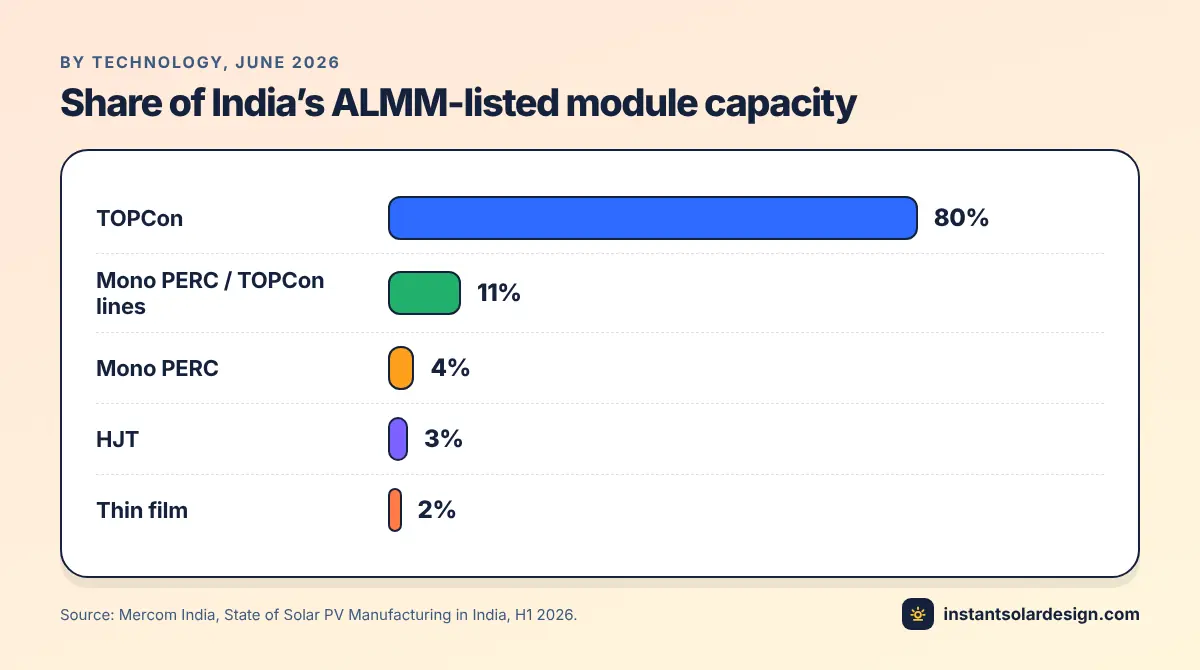
Industry panels in 2026 described demand for Mono PERC as tapering. The main exception has been domestic-content projects, because many Indian cell lines were built for PERC first. As new TOPCon cell lines start, that exception should fade. Forecasts suggest TOPCon will remain the dominant technology in India for the next five to six years, with back-contact designs growing at the premium end.
How the technologies differ
Mono PERC
PERC (Passivated Emitter and Rear Cell) adds a passivation layer to the back of a standard p-type silicon cell, reflecting light back into the cell and reducing losses. It was the workhorse of the solar industry for years. Its weaknesses are a relatively higher temperature coefficient, more light-induced degradation in the first year and lower bifaciality.
TOPCon
TOPCon (Tunnel Oxide Passivated Contact) usually uses n-type silicon and a very thin oxide layer under the rear contact. The result is higher efficiency, lower degradation and better performance in heat. Because the process can be added to existing production lines with moderate changes, manufacturers scaled it quickly, which kept its price close to PERC.
HJT
Heterojunction cells sandwich crystalline silicon between thin layers of amorphous silicon. They have the lowest temperature coefficient of the three and very high bifaciality, and they degrade slowly. The production process is different from PERC and TOPCon, needing new equipment and silver-heavy metallisation, which is why HJT costs more and is made by fewer factories.
Comparing the numbers
Exact values depend on the manufacturer and model, but typical 2026 datasheets fall in these ranges:
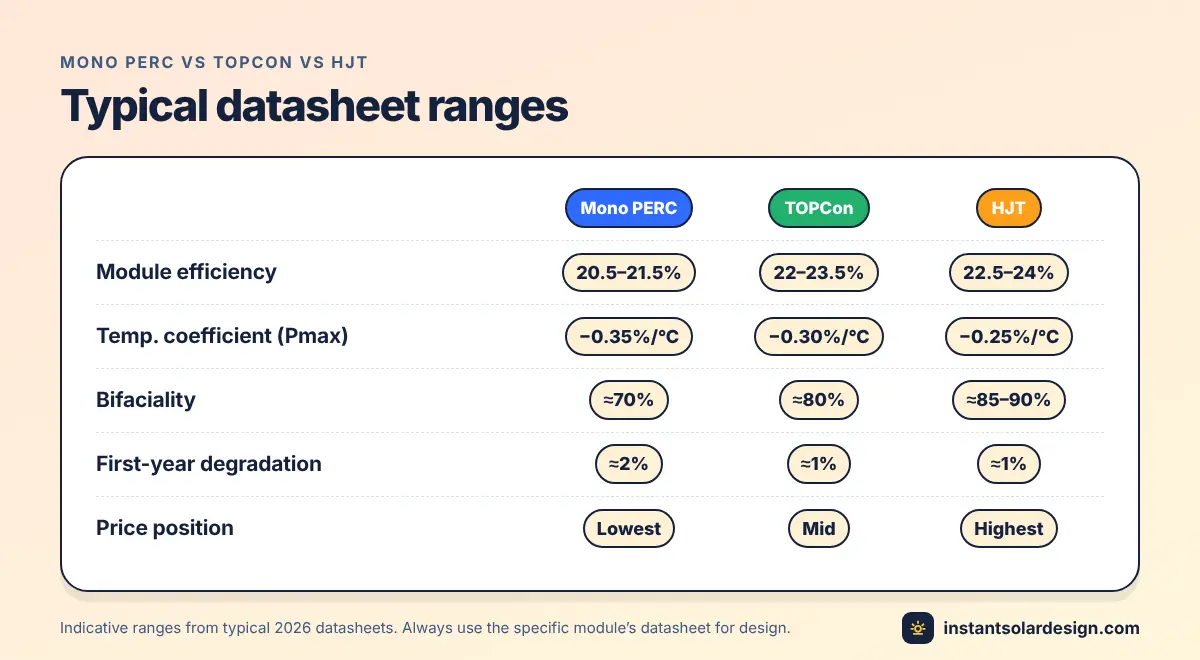
Two of these numbers matter more in India than in cooler countries.
Temperature coefficient
Panels lose output as they heat up. Datasheet power is rated at 25°C cell temperature, but on an Indian roof in April or May, cells can easily run 40°C hotter than that. Using typical coefficients:
- Mono PERC at −0.35%/°C loses about 14% of rated power at 40°C above 25°C.
- TOPCon at −0.30%/°C loses about 12%.
- HJT at −0.25%/°C loses about 10%.
Over a year, the difference between PERC and TOPCon in hot regions can be worth a few percent of energy. That is often enough to justify TOPCon’s small premium on its own.
Degradation
First-year degradation and annual degradation together decide how much energy a module produces over 25 years. N-type technologies (TOPCon and HJT) usually carry lower first-year loss and lower annual degradation in their warranties than p-type PERC. Read the specific power warranty, not just the technology name.
Bifacial modules: when the back side matters
Bifacial modules generate from both faces. The back side collects light reflected from the surface below. How much extra energy that gives depends on the installation:
- Flat RCC roofs with low mounting: little benefit, because the back side sees a dark, close surface.
- Elevated structures over white or reflective roofs: a useful gain, often a few percent.
- Ground-mounted plants over light soil or gravel: the best case for bifaciality.
Most TOPCon and HJT modules sold in India are glass-glass bifacial. If the installation will not benefit from the back side, the extra weight and cost of glass-glass may not be worth it on a light structure — check the roof and structure design. Our guide on solar on metal sheds covers weight concerns for industrial roofs.
Which technology for which project?
| Project | Usual best choice | Reason |
|---|---|---|
| Subsidised home (DCR needed) | Whatever DCR stock is reliable — PERC or TOPCon | Subsidy rules come first; check availability |
| Private home, small roof | TOPCon | More watts per square metre, good heat performance |
| C&I flat roof, elevated structure | Bifacial TOPCon | Good balance of cost, heat and back-side gain |
| Metal shed, weight-limited | Light glass-backsheet module | Structure limits matter more than bifaciality |
| Ground mount, hot region | Bifacial TOPCon or HJT | Heat and albedo gains; HJT if the premium pays |
What the difference looks like on a real roof
Technology claims are easier to judge in kWh. Take an illustrative 5 kW rooftop in a hot region. If a Mono PERC system there produces about 7,200 kWh in its first year, a TOPCon system of the same rated power would typically produce a few percent more, mainly because it loses less output in summer heat and less in its first year. At a 3% advantage that is roughly 200 kWh a year — about ₹1,500 at ₹7 per unit.
That looks small in year one. The gap widens over time because n-type modules usually carry lower annual degradation in their warranties. Over 25 years, the cumulative difference can reach several thousand kWh, which comfortably covers a small price premium. The same logic, with bigger numbers, applies to C&I roofs, where the gain is multiplied across hundreds of kilowatts.
The exact figures depend on the site, the modules and the mounting, so use a proper generation simulation for each option rather than a rule of thumb.
Warranty terms worth comparing
- Product warranty: the years covered for manufacturing defects. Longer is better, and it matters more than the headline power warranty for early failures.
- Performance warranty: the guaranteed share of rated power at year 25 or 30. Compare the end value and the yearly degradation rate.
- First-year degradation: usually higher for p-type PERC than for n-type TOPCon and HJT.
- Who honours the warranty in India: a warranty from a company with no local presence is hard to claim. Ask how claims are handled and how long they take.
The supply reality
The best technology on paper is only useful if you can buy it on time, with the right compliance. Three supply questions matter more than datasheets in 2026:
- Does the project need domestic cells? For PM Surya Ghar, PM-KUSUM and government projects, it does — and for ALMM-covered net-metered and open-access projects from 2027 too. Domestic TOPCon cell supply has been tighter than PERC. See DCR vs non-DCR panels.
- Is the model on ALMM List-I? Check the exact model and wattage, not just the brand.
- Is the module size compatible with your structure? Newer high-wattage modules are larger and heavier. A change of module can change the number of panels that fit, the purlin spacing and the wind-load design.
Explaining the choice to customers
Customers see wattage first. A useful way to explain technology is in rupees per unit of energy over the system’s life, not rupees per panel:
“This TOPCon panel costs a little more than the older PERC type, but it loses less power in summer heat and degrades more slowly, so over 25 years it produces more electricity for each rupee you spend.”
Show the generation estimate for both options from your design software or design partner. Customers trust a number for their own roof far more than a technology claim. For homeowners who ask brand-specific questions, our post on answering “which panel will you use?” helps.
What’s next: back-contact and beyond
Back-contact cells move all electrical contacts to the rear, removing front-side shading from busbars and raising efficiency further. They are growing globally at the premium end and are expected to appear more in India over the next few years. Perovskite-silicon tandem cells promise even higher efficiency but are not yet a commercial rooftop option in India. For 2026–27 project planning, TOPCon remains the safe default.
Checklist before you finalise a module
- Confirm compliance needs: DCR, ALMM List-I, List-II.
- Compare temperature coefficient and warranty degradation, not only wattage.
- Decide whether bifaciality will actually add energy on this site.
- Check module dimensions and weight against the structure design.
- Re-run the layout and generation estimate for the exact model.
- Confirm delivery time from the supplier before promising a commissioning date.
Technical ranges are indicative values from typical 2026 datasheets; market shares are as reported by Mercom for June 2026. Use the specific module’s datasheet and warranty for design and sales.
Compare modules on the real roof
See the layout and kWh for each option.
We design the roof with your chosen modules and give generation estimates you can show the customer — from ₹500 per project.
Order a design →Frequently asked questions
Is TOPCon better than Mono PERC?
In most Indian conditions, yes. TOPCon modules typically have higher efficiency, a lower temperature coefficient and lower degradation than Mono PERC, for a small price premium.
What share of India’s module capacity is TOPCon?
About 80% of ALMM-listed module manufacturing capacity was TOPCon as of June 2026, according to Mercom.
Is HJT worth the extra cost?
HJT has the best heat performance and bifaciality, which can pay off on hot ground-mounted or elevated bifacial projects. For most rooftops, TOPCon offers a better balance of price and performance.
Do bifacial panels help on a flat RCC roof?
Usually only a little, because the back side faces a dark, close surface. Bifacial gains are larger on elevated structures over reflective surfaces and on ground mounts.
Why do DCR projects often use Mono PERC?
Many Indian cell lines were built for PERC first, so domestic-content supply has been PERC-heavy. This is changing as Indian TOPCon cell lines start production.