Solar Market · · Updated · 8 min read
GST on Solar in India (2026): How the 5% Rate Changes Rooftop Quotes
Few changes in the last two years affected rooftop quotations as directly as the GST cut on solar. From 22 September 2025, the GST rate on renewable energy devices, including solar modules, fell from 12% to 5%. Customers read about it in the news and expected cheaper quotes the next week. Many installers were not sure how much the price should actually fall.

This guide explains how GST applies to rooftop solar after the change, works through an example, and shows how to present tax on a quotation so customers understand it. It is written for installers and EPCs, but homeowners comparing quotes will find it useful too.
What changed, and when
The GST Council approved the rate cut at its 56th meeting on 3 September 2025, and it took effect on 22 September 2025. Renewable energy devices and their parts that were taxed at 12% moved to 5%. Government estimates put the saving on a typical 3 kW home system at about ₹9,000–10,500, on a 5 HP solar pump at about ₹17,500, and on utility-scale projects at around ₹20–25 lakh per MW.
Some industry estimates were lower — one large developer suggested around ₹5,000 for a residential system — because the saving depends on how the system is billed, which is the next point.
Why the saving is not simply 7%
A rooftop solar job is not just a box of goods. It includes design, installation, wiring, earthing, commissioning and paperwork. GST law treats goods and services differently: services are generally taxed at 18%.
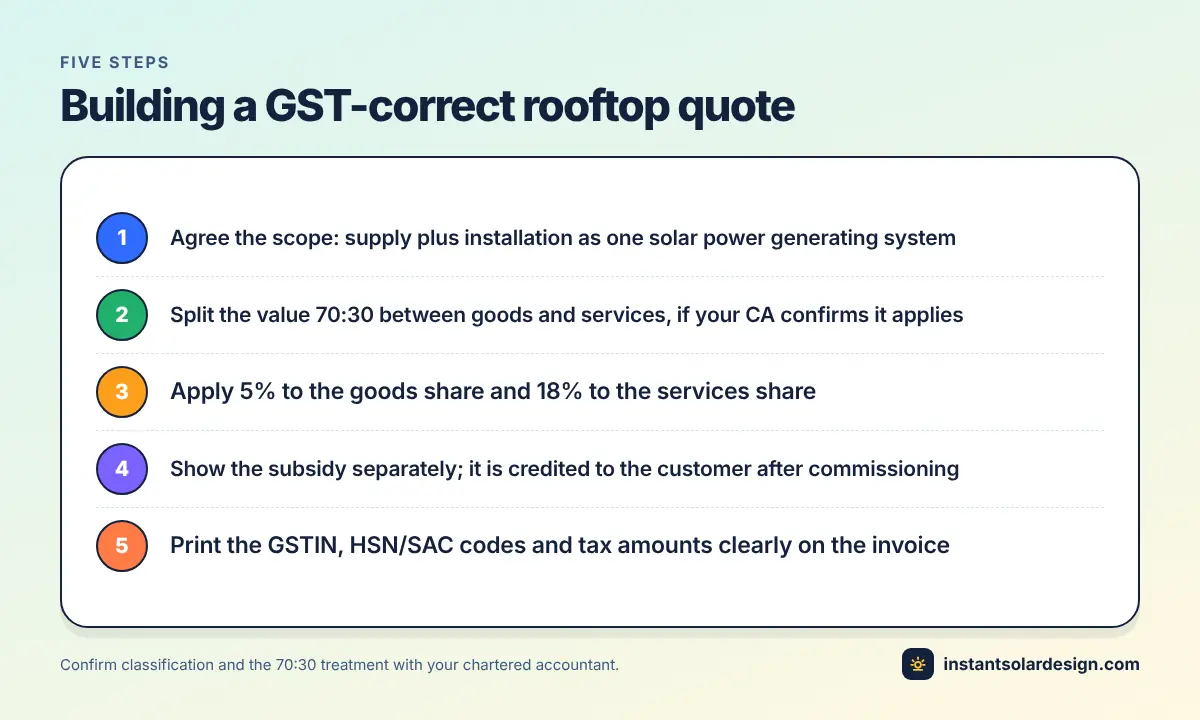
For solar power generating systems supplied with installation, GST practice has used a deemed split in which 70% of the contract value is treated as goods and 30% as services. Under the old rates, that gave an effective rate of roughly 13.8% (70% × 12% + 30% × 18%). With goods now at 5%, the same split gives roughly 8.9% (70% × 5% + 30% × 18%).
| Goods share (70%) | Services share (30%) | Effective rate | |
|---|---|---|---|
| Before 22 Sep 2025 | 12% | 18% | ≈ 13.8% |
| From 22 Sep 2025 | 5% | 18% | ≈ 8.9% |
So the effective tax on a full system fell by about 4.9 percentage points, not 7. That is why a ₹2 lakh system does not become ₹14,000 cheaper overnight. Whether the 70:30 split applies to your contracts depends on how you supply and invoice — confirm it with your chartered accountant.
A worked example: 3 kW home system
Take an illustrative 3 kW system with a pre-tax value of ₹1,80,000, billed as one supply with installation:
- Goods (70%): ₹1,26,000. Old GST at 12% = ₹15,120. New GST at 5% = ₹6,300.
- Services (30%): ₹54,000. GST at 18% = ₹9,720 in both cases.
- Total GST: ₹24,840 before, ₹16,020 after — a saving of ₹8,820.
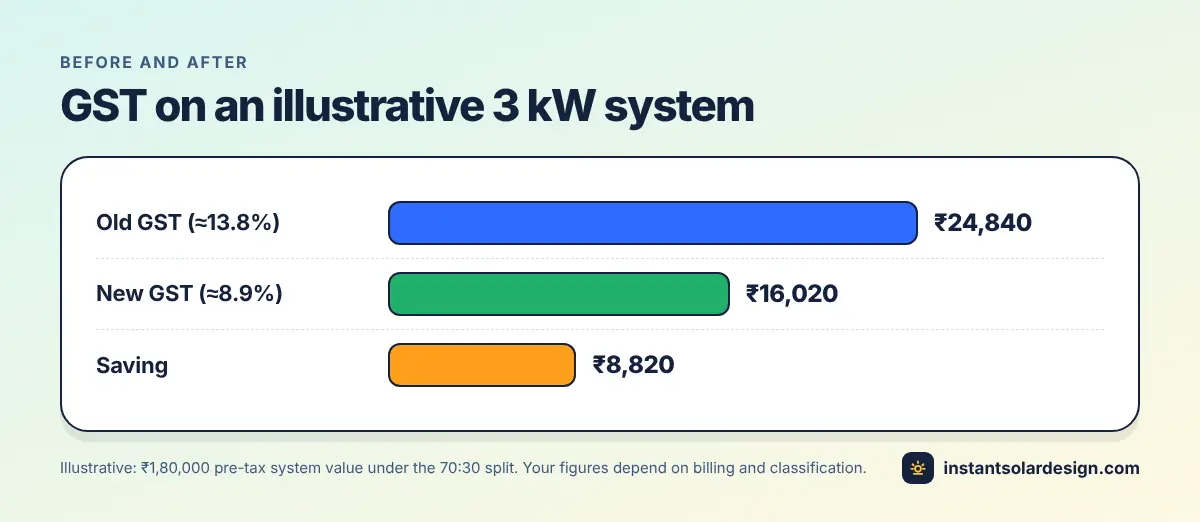
That lands close to the government’s ₹9,000–10,500 estimate. The customer’s final price also depends on what happened to module prices, freight and labour in the same period, so the real change on a quote can be larger or smaller.
Components that need a closer look
Installers disagree most about three items:
Inverters
Sources differ on whether a solar inverter sold on its own is taxed at the renewable-device rate or at 18%. A common view is that an inverter supplied as part of a complete solar power generating system follows the system treatment, while one sold separately as a spare or replacement is taxed at 18%. Get your classification confirmed in writing.
Mounting structures and balance of system
Structures, cables, earthing kits and junction boxes supplied as part of the system usually follow the system treatment. Sold separately, they may attract their own rates. This matters for maintenance and upgrade jobs.
Batteries
Batteries for hybrid systems have their own classification and rate. If you are quoting a solar system with battery storage, show the battery as a separate line and check its rate with your CA.
Updating your per-kW price card
Most installers sell from a simple price card: a rate per kW for common system sizes. After the GST change, it is worth rebuilding the card from the pre-tax price so the tax line is correct for every size. Using an illustrative pre-tax price and the 70:30 treatment:
| System | Pre-tax value | GST at ≈13.8% (old) | GST at ≈8.9% (new) | New total |
|---|---|---|---|---|
| 2 kW | ₹1,25,000 | ₹17,250 | ₹11,125 | ₹1,36,125 |
| 3 kW | ₹1,80,000 | ₹24,840 | ₹16,020 | ₹1,96,020 |
| 5 kW | ₹2,90,000 | ₹40,020 | ₹25,810 | ₹3,15,810 |
The pre-tax values are only examples; use your own costs. Two things are worth noticing. First, the saving grows with system size, so larger homes and small businesses notice it most. Second, because the services share is still taxed at 18%, installers who bill a large installation or design component separately may see a smaller saving than the headline suggests.
When you rebuild the card, also check your structure and cabling costs. Many installers found that steel and labour moved in the same months, which is why some customers did not see the full GST saving in the final price — and why showing the breakdown matters.
How GST interacts with the PM Surya Ghar subsidy
The central financial assistance under PM Surya Ghar is credited to the customer’s bank account after the system is commissioned and inspected. The installer invoices the full price including GST, and the customer pays it — either upfront or through a loan — and then receives the subsidy. GST is calculated on the transaction value, not on the price after subsidy.
When you show a customer the “effective cost”, make the order clear:
- System price before tax
- GST
- Total invoice value
- Expected subsidy (credited later)
- Net cost to the customer
Customers who see the subsidy deducted on the invoice itself often get confused when the bank statement does not match. Our PM Surya Ghar guide covers the subsidy slabs and process.
Mistakes we see on rooftop quotations
- Applying 5% to the whole contract. Unless your supply structure supports it, the installation share is usually taxed at 18%. Under-charging GST does not make the tax disappear — it comes out of your margin later.
- Quoting “GST extra” without a number. Customers compare totals. Show the tax amount and the final figure.
- Old price lists. Supplier invoices after September 2025 should show 5% on modules. If you are still being billed 12% on module supply, ask why.
- Mixing subsidy into the invoice. Keep the subsidy as a separate line on the quotation, not as a discount on the tax invoice.
- Not passing on the saving. In a competitive market, customers notice. Being transparent about the GST change builds trust.
What it means for C&I and larger projects
For commercial and industrial customers who are registered under GST, the tax on a solar plant can often be claimed as input tax credit, depending on how the plant is used and capitalised. For them, the GST rate affects cash flow more than final cost. For customers who cannot claim credit — homes, many schools, hospitals and trusts — the lower rate is a direct saving.
For ground-mounted and larger rooftop projects, the absolute saving is significant. At ₹20–25 lakh per MW, it can change the result of a tight payback calculation. If you prepared proposals before September 2025 that a customer has not yet signed, it is worth re-issuing them with the new tax figures.
Explaining it to a customer in one minute
A short, honest explanation works better than a lecture on tax law:
“The government cut GST on solar equipment from 12% to 5%. The equipment part of your system is now taxed at 5%, and the installation work is still at 18%. Overall, the tax on your system has gone down by about ₹9,000. Here is the breakdown.”
Then show the table. Customers rarely argue with a quote they can follow line by line.
Checklist for installers
- Confirm your supply structure and the 70:30 treatment with your CA.
- Update quotation and invoice templates with separate goods and services lines where applicable.
- Check supplier invoices for the correct rate on modules.
- Show subsidy separately from the tax invoice.
- Re-issue open proposals prepared before 22 September 2025.
- Keep classification notes for inverters, batteries and spares.
This article explains general GST treatment as reported up to November 2026. It is not tax advice. Rates and classifications can change; confirm the treatment for your contracts with a qualified chartered accountant.
Win the quote, not just the tax argument
Send a proposal with a real 3D design.
We prepare rooftop layouts, shadow analysis and generation estimates you can attach to every quotation — from ₹500 per project.
See design prices →Frequently asked questions
What is the GST rate on solar panels in India in 2026?
Solar modules and other renewable energy devices are taxed at 5% since 22 September 2025, down from 12%.
What is the effective GST on a rooftop solar system?
If the contract is treated under the 70:30 split, the effective rate is roughly 8.9% (5% on 70% goods and 18% on 30% services), down from about 13.8% before the change.
How much does the GST cut save on a 3 kW system?
Government estimates put the saving at about ₹9,000–10,500 for a typical 3 kW home system. Our illustrative calculation for a ₹1.8 lakh system gives about ₹8,800.
Is GST charged on the subsidy amount?
GST is charged on the full transaction value. The PM Surya Ghar subsidy is credited to the customer after commissioning and does not reduce the tax on the invoice.
What GST applies to solar inverters?
Treatment varies. An inverter supplied as part of a complete system usually follows the system treatment, while a standalone inverter may be taxed at 18%. Confirm with your chartered accountant.
Sources
- pv magazine — India solar module and cell prices fall after GST cut to 5%
- Energetica India — GST cut makes rooftop solar cheaper by ₹10,500 for 3 kW
- Tribune India — GST on renewable energy devices rationalised to 5%
- Mercom — Revised GST for rooftop solar systems with central financial assistance
- Free Press Journal — GST cut reduces 3 kW rooftop price by ₹10,500